Cookline and Equipment Areas
Degreasing for accessible equipment exteriors, sides, legs, casters, splash areas, walls, and floors. Equipment movement is agreed in advance according to weight, utility connections, and safe access.
Serving Seattle, Washington & surrounding areas
Open 24/7
Restaurant Cleaning · Seattle
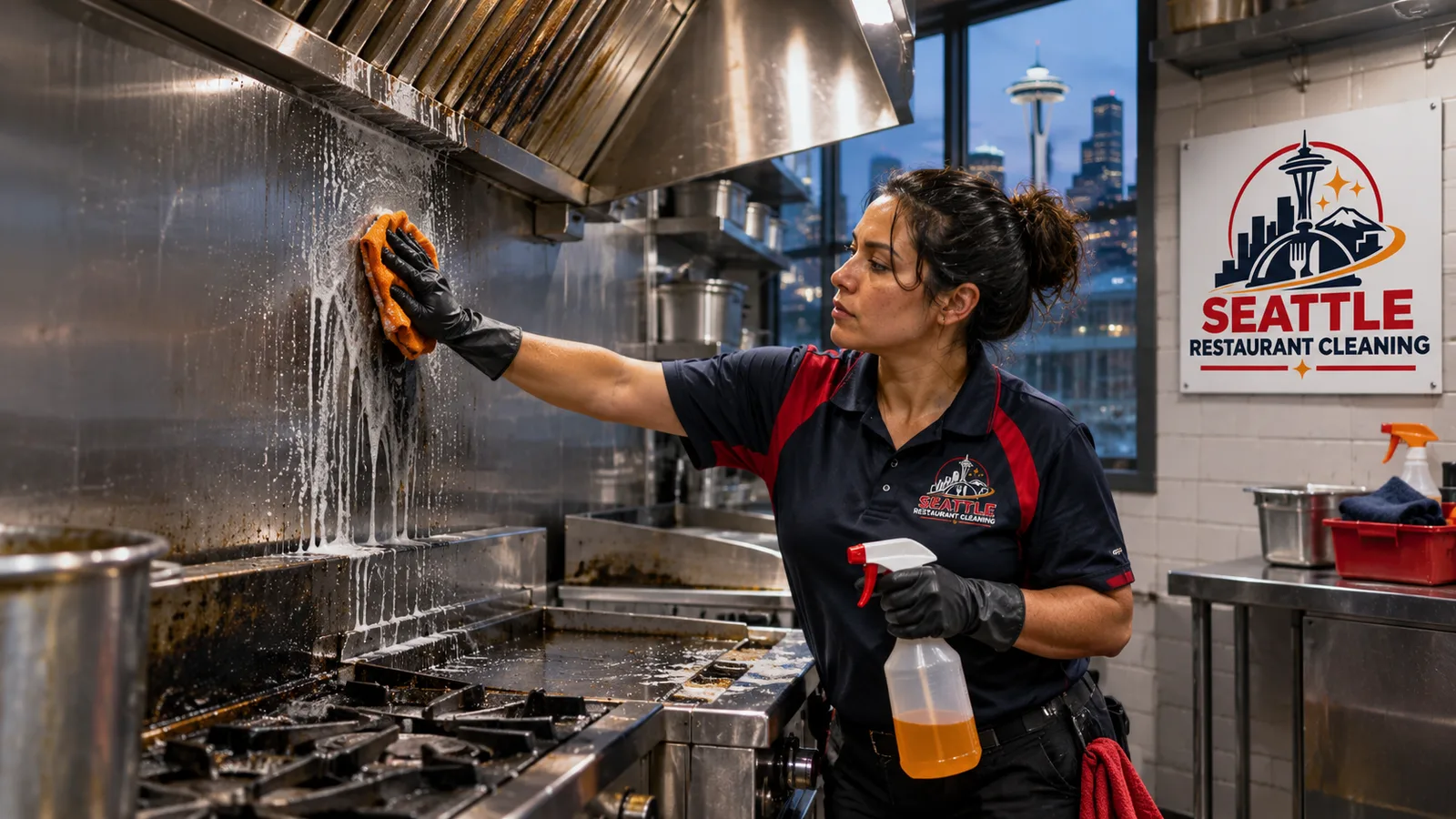
Detailed cleaning for commercial kitchens, dining rooms, walk-in coolers, storage areas, and overhead surfaces, scheduled around your operating hours.
Built Around Your Operation
A restaurant cleaning company should understand that a commercial kitchen cannot be treated like a standard office. Grease migrates beyond the cookline, food debris collects under equipment, and moisture can turn overlooked cooler surfaces into recurring trouble spots. Seattle Restaurant Cleaning develops written scopes for kitchens, dining rooms, bars, storage spaces, employee areas, and other agreed work zones.
We are Seattle's restaurant service specialists who plan the work around access, equipment, operating schedules, and the condition of each area. That may mean a one-time reset before an inspection, periodic deep cleaning, or recurring detailed service that complements the restaurant's daily sanitation routine. The scope identifies what will be cleaned, which equipment can be moved, where shutdown or cool-down time is needed, and what the restaurant team should prepare before arrival.
Our location on S Massachusetts Street provides a practical base near Seattle's industrial and restaurant corridors. Pioneer Square businesses often work within older commercial buildings where access, stairs, and compact back-of-house layouts affect the plan. Capitol Hill restaurants may have tight kitchens and late operating hours. Ballard breweries and restaurants can combine food production, bar service, and high overhead structures in one facility. In SoDo, larger kitchens and loading access may permit more equipment movement, but the work area still needs careful coordination.
Beyond Closing Duties
Daily closing work handles immediate food-contact sanitation and visible soil. Kitchen deep cleaning reaches the buildup that remains around, under, and behind equipment. A detailed scope may cover floors and edges, baseboards, walls, washable ceilings, doors, shelving, stainless steel exteriors, equipment sides, casters, legs, floor drains, and accessible spaces beneath the cookline.
Commercial kitchen deep cleaning in Seattle often requires close attention to grease migration. Aerosolized grease settles on nearby walls, pipes, conduit, ledges, and equipment surfaces. Appropriate degreasers need dwell time to loosen that film before agitation and removal. Technicians must also control water near electrical components, pilot assemblies, controls, and sensitive equipment.
Food-contact parts and cooking appliances require equipment-specific handling. Restaurant staff should identify manufacturer restrictions, lockout needs, and components that cannot be wet cleaned. Hood duct and exhaust-system cleaning is a specialized fire-safety service and should not be confused with general cleaning of accessible hood exteriors or surrounding surfaces. The written scope should state that distinction clearly.
Facility-Wide Scope
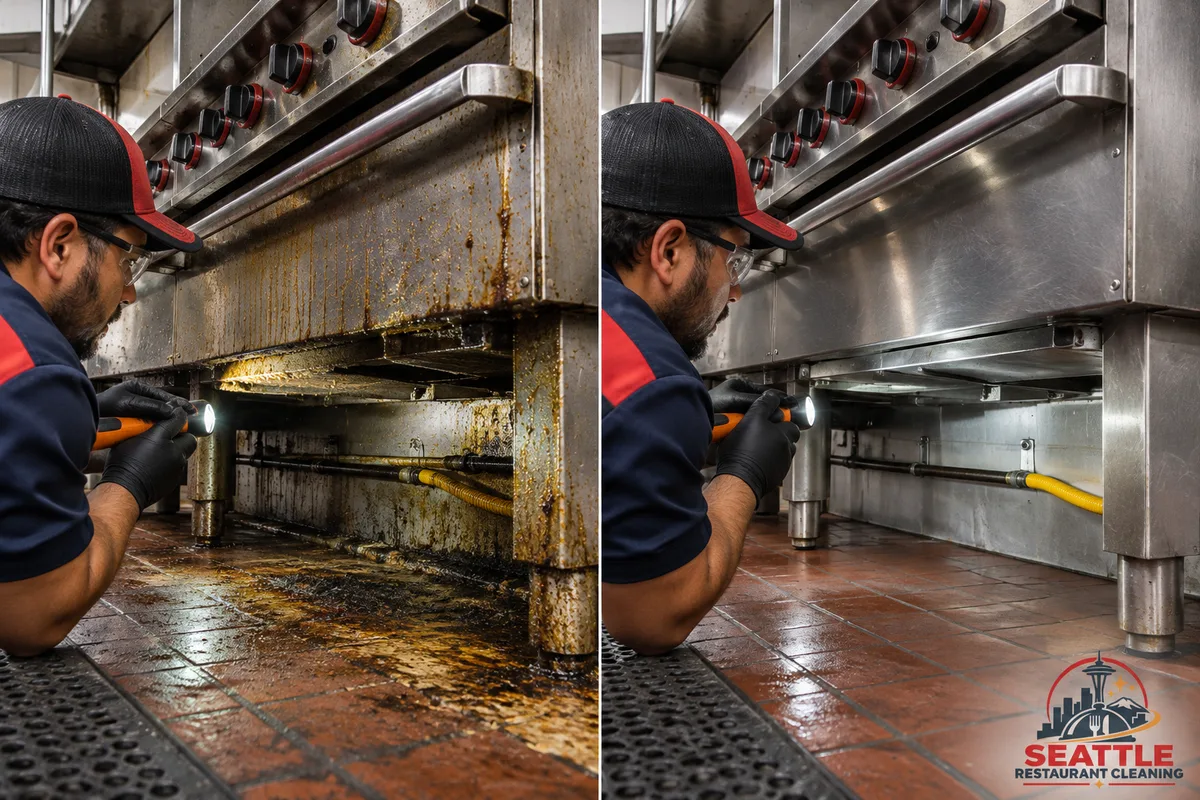
Degreasing for accessible equipment exteriors, sides, legs, casters, splash areas, walls, and floors. Equipment movement is agreed in advance according to weight, utility connections, and safe access.
Detailed cleaning for floors, baseboards, washable wall surfaces, furniture contact points, ledges, bar exteriors, and other agreed areas that routine service may miss.
Cleaning for empty shelving, walls, floors, doors, gaskets, and accessible evaporator surrounds, with products and methods selected for a food-storage environment.
Removal of settled dust from accessible beams, pipes, vents, light exteriors, ledges, and structural surfaces using suitable extension tools or access equipment.
Detailed work around shelving, dry-storage floors, corners, doors, washable surfaces, and accessible spaces behind movable items after food and supplies are secured.
Focused cleaning for restaurant openings, management transitions, equipment changes, seasonal resets, or recovery after heavy use.
Cold-Storage Detail
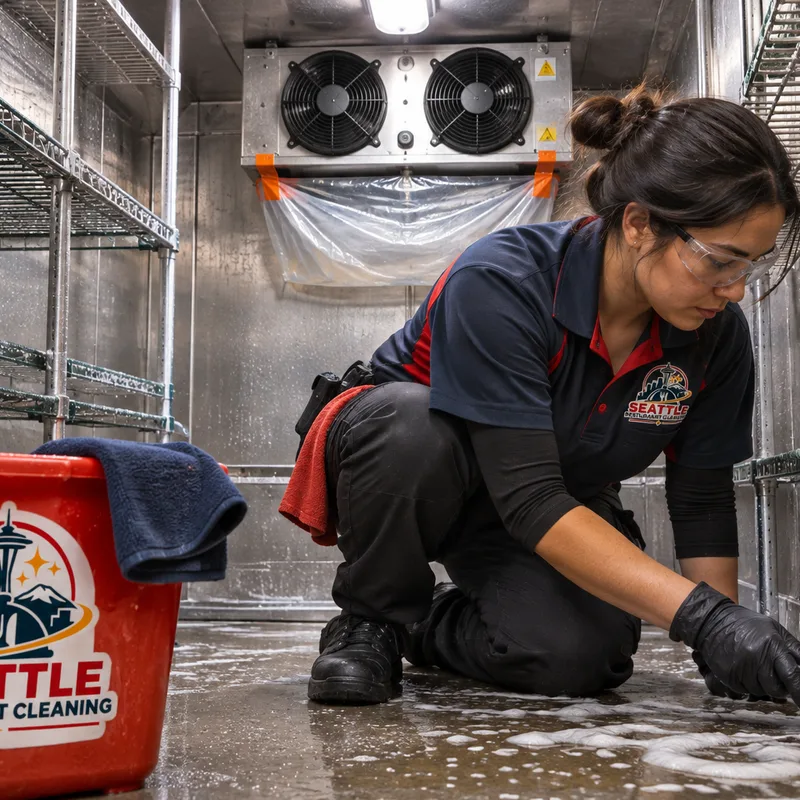
Walk-in cooler cleaning requires more than mopping the floor. Before service, exposed food should be removed or securely protected, and shelving should be cleared when the scope includes shelf surfaces. Cleaning can then address spills, residue, door tracks, handles, gaskets, walls, empty racks, floor edges, and accessible areas around refrigeration components.
Condensation and repeated door openings can leave wet areas that collect soil. Cleaners should avoid flooding insulated panels, electrical parts, controls, fans, and refrigeration equipment. Products must be suitable for the surface and rinsed when the label requires it. After cleaning, surfaces should be left free of pooled water before food is returned.
A cleaner can remove surface soil and report visible concerns, but damaged gaskets, persistent condensation, drain trouble, or refrigeration faults need the appropriate repair professional. If visible microbial growth is extensive or tied to a building moisture problem, the condition may require assessment beyond routine restaurant detailed cleaning.
High dusting removes settled material from overhead surfaces that are difficult to reach during routine cleaning. Common targets include exposed beams, pipes, conduit, vent exteriors, light exteriors, upper ledges, ceiling fans, and structural decking. The exact scope depends on ceiling height, surface condition, access, and whether equipment can remain safely beneath the work.
Seattle's long wet season can increase the amount of moisture carried through entrances and service areas. When that moisture combines with cooking residue and airborne dust, deposits may adhere more firmly to nearby surfaces. Overhead work should therefore be planned before lower-level detailed cleaning so dislodged material can be captured and the floor and equipment areas can be finished afterward.
High dusting in Seattle may require extension-vacuum tools, ladders, or lift access. Before work starts, the crew should identify sprinkler heads, alarms, fragile fixtures, electrical hazards, and occupied zones. Food, clean utensils, and preparation surfaces must be removed or protected. Work at height should never interfere with active cooking or customer traffic.
01
We review the cookline, cooler, dining areas, storage spaces, overhead surfaces, access points, utilities, and visible soil. Photos and notes can help define the requested result.
02
The scope lists included areas, exclusions, preparation duties, equipment movement, access requirements, and any surfaces that need testing or special handling.
03
Work may be planned after closing, on a dark day, or during another approved service window. The restaurant confirms alarms, keys, parking or loading access, and an on-site contact.
04
Food and clean wares are secured, sensitive equipment is identified, and the work zone is isolated as needed. Equipment is cooled or shut down when the agreed method requires it.
05
Crews generally work from overhead surfaces toward lower surfaces, then complete floors and accessible drains. Degreasers receive appropriate dwell time, and residue is removed according to product directions.
06
The completed areas are checked against the scope. Any inaccessible location, damaged surface, repair concern, or item outside the agreed work is documented for the restaurant contact.
Scope and Safety
A useful proposal should describe the work by area and surface rather than promise a generic deep clean. Ask whether the quoted service includes equipment sides, spaces beneath movable units, cooler shelving, floor drains, walls, high ledges, and dining-room details. Confirm who moves heavy equipment, who disconnects utilities, and whether the kitchen must be cool before the crew arrives.
Also ask how chemicals are selected and whether product labels and safety data sheets are available. Food-contact surfaces require appropriate handling, and some metals, painted finishes, stone, grout, and rubber components can be damaged by the wrong chemistry or excessive abrasion. A test area is sensible when a surface is delicate or its prior treatment is unknown.
Professional restaurant deep cleaning should fit into the facility's broader food-safety program. In Seattle, restaurants operate under requirements administered by Public Health, Seattle & King County. Cleaning can support a sanitary facility, but it does not guarantee an inspection result and does not replace employee food-safety procedures, pest management, equipment repair, or required exhaust-system service.
Share the areas that need attention, your operating schedule, and any access limits. We will help define a practical scope before the cleaning date.
Call for a Free QuotePractical Answers
Restaurant deep cleaning is priced after the facility and requested scope are reviewed. Cost depends on kitchen size, grease level, equipment movement, cooler condition, ceiling height, access, parking or loading constraints, and whether the work must be divided across service windows. A compact kitchen with accessible surfaces requires a different plan than a large operation with heavy buildup and lift-dependent high dusting. A written estimate should identify inclusions and exclusions before scheduling.
Yes, after-hours work can be planned when access, noise, alarms, shutdown procedures, and an authorized contact are arranged in advance. Capitol Hill restaurants with late service may need an overnight plan, while facilities with a weekly dark day may prefer a daytime deep clean. Cooking equipment must have enough time to cool when the cleaning method requires direct work around hot surfaces.
The duration depends on the number of work zones, buildup, access, and crew size. A focused cookline or walk-in cooler service may fit within one service window, while a whole-facility clean with high dusting can require a longer shutdown or staged visits. The walk-through should establish the expected duration and identify which areas must remain unavailable during the work.
Food should be removed from the active work area or sealed and relocated according to the agreed preparation plan. Empty shelves allow more complete cleaning of racks, walls, edges, and floors. The restaurant remains responsible for food-temperature control during removal and return, and refrigeration components should stay protected from excess water.
General kitchen deep cleaning may include accessible hood exteriors and nearby surfaces only when they are written into the scope. Internal hood, fan, and duct cleaning is specialized work tied to the exhaust system and fire-safety requirements. The proposal should state exactly which hood surfaces are included so restaurant cleaning is not mistaken for certified exhaust-system service.
The restaurant should secure food and clean utensils, clear agreed shelves and counters, identify sensitive or damaged surfaces, arrange keys and alarm access, and cool or shut down equipment as required. Heavy units should remain connected unless qualified personnel have approved movement. SoDo facilities with loading access should reserve it when equipment or lift access is part of the plan.
Detailed cleaning can address visible soil and hard-to-reach areas before an inspection, but it cannot guarantee an inspection outcome. Public Health, Seattle & King County evaluates food-safety practices and facility conditions that extend beyond cleaning. Restaurants should also review temperature control, employee practices, pest activity, equipment condition, and any prior inspection findings.
Tell Seattle Restaurant Cleaning which areas need work and when the facility is available. We will help turn those needs into a clear scope for the kitchen, cooler, dining room, storage areas, and overhead surfaces.