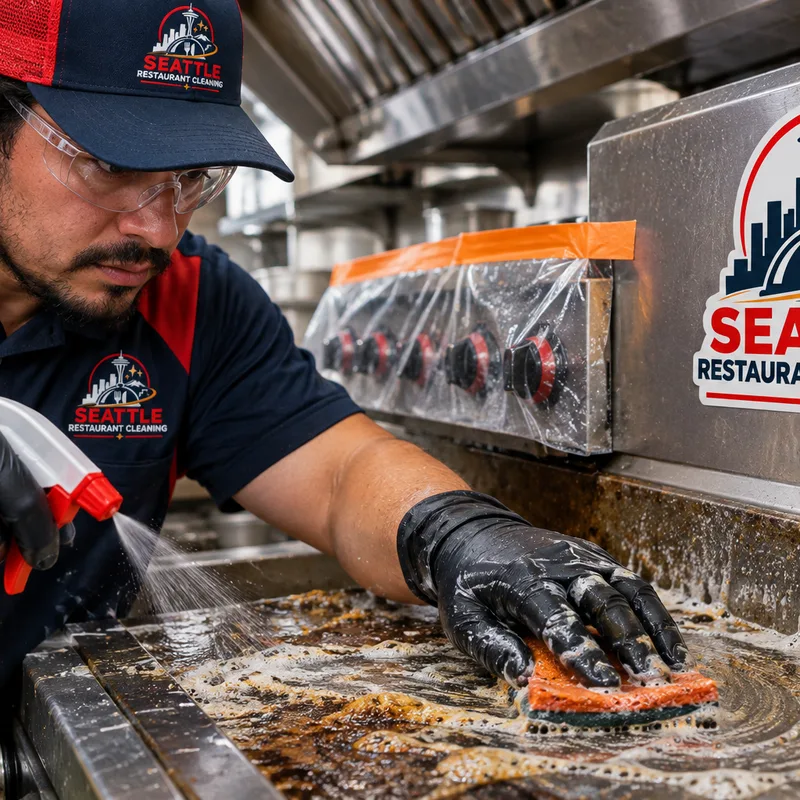
Cooking Equipment
Degreasing and detailed cleaning for accessible parts of ranges, ovens, fryers, griddles, charbroilers, salamanders, and other cooking equipment. The agreed scope identifies which components can be moved, opened, or safely cleaned.
Serving Seattle, Washington & surrounding areas
Open 24/7
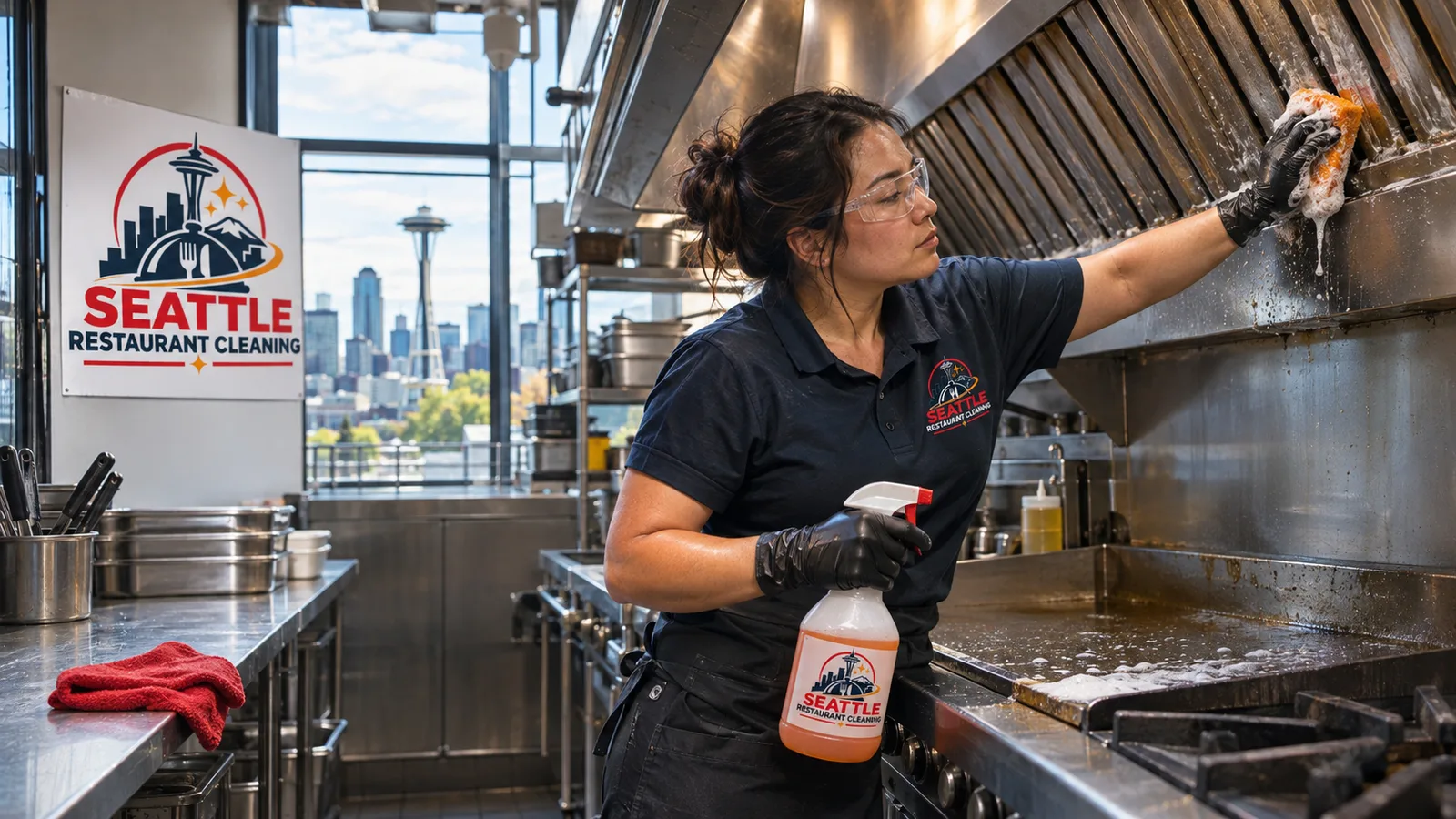
Commercial Kitchen Cleaning · Seattle
Detailed cleaning for cooking equipment, exhaust areas, grease traps, floors, walls, and other hard-working kitchen surfaces, scheduled around your operation.
Cleaning Planned Around Service
Commercial Kitchen Cleaning Services remove the grease, carbon buildup, food residue, and grime that ordinary closing routines cannot fully address. Seattle Restaurant Cleaning develops the scope around your equipment, kitchen layout, operating hours, and priority areas. Work can be planned as a one-time deep clean or a recurring service.
As a professional restaurant service company in Seattle, we focus on practical details that matter during service: access around fixed equipment, chemical compatibility with food-preparation surfaces, attention to corners and casters, and a clear handoff when the work is complete. Our address near SODO provides a practical base for serving commercial kitchens across the city.
Seattle's food operations vary widely. Compact kitchens around Pike Place Market may require careful staging and restricted loading plans. Capitol Hill restaurants often need overnight work to accommodate late service, while larger kitchens in SODO may have more equipment, floor area, and grease-producing stations. In Ballard, cleaning plans may need to fit busy dinner and weekend schedules. The scope is set around the actual facility rather than a generic checklist.
Degreasing and detailed cleaning for accessible parts of ranges, ovens, fryers, griddles, charbroilers, salamanders, and other cooking equipment. The agreed scope identifies which components can be moved, opened, or safely cleaned.
Cleaning for stainless steel worktables, shelving, sinks, backsplashes, exterior refrigeration surfaces, and food-preparation areas using methods suited to each material.
Scrubbing targets grease films around cooklines, under movable equipment, along wall edges, near floor drains, and in corners that routine mopping can miss.
Service planning can address accessible grease-control equipment, buildup, and surrounding sanitation needs. Restaurant grease trap cleaning in Seattle must account for access, capacity, condition, and proper handling of removed material.
Cleaning can include accessible hood surfaces, filters, and exhaust-system components within the documented scope. Restaurant hood cleaning in Seattle should be assessed separately from ordinary surface degreasing because access and system condition affect the work.
Commercial kitchen deep cleaning can prepare a facility for an opening, inspection, seasonal reset, management change, or maintenance program. Recurring schedules help keep heavy buildup from returning between major cleanings.
Surface-Specific Methods
Professional kitchen cleaning starts with identifying the soil and the surface beneath it. Heavy grease may require dwell time with a commercial degreaser before agitation and controlled rinsing. Carbonized deposits on cooking equipment call for different tools than grease film on stainless steel. Painted walls, rubber flooring, aluminum filters, electrical controls, and food-contact surfaces cannot all be treated the same way.
Kitchen equipment cleaning also requires boundaries. Gas connections, electrical components, pilot assemblies, sensitive controls, and manufacturer-restricted parts must be protected. Equipment is moved only when access, weight, utility connections, and the approved scope allow it. Cleaners should never flood an area simply because a floor drain is present.
Food-contact surfaces receive a final treatment appropriate to their intended use. Cleaning removes soil; sanitizing is a separate step performed on a surface that has already been cleaned. Chemicals must be used according to their labels, including dilution, contact time, rinsing, and required personal protective equipment.
01
We review the cookline, preparation areas, floors, walls, drains, accessible exhaust areas, grease-control equipment, and any problem spots. Access limits and operating hours are discussed before the scope is set.
02
The plan identifies included surfaces and equipment, exclusions, cleaning methods, scheduling, and any preparation required from kitchen staff. This keeps expectations clear for both the manager and cleaning crew.
03
Food and loose utensils must be removed or secured. Sensitive controls and adjacent areas are protected, and movable items are staged so cleaners can reach the agreed work zones safely.
04
The crew works through the planned areas using scraping, agitation, commercial degreasers, detail tools, and controlled rinsing or extraction where appropriate. Soil is removed rather than spread across nearby surfaces.
05
Accessible work areas are checked against the scope. Any condition that could not be resolved through cleaning, such as damaged seals, corrosion, or an inaccessible component, is documented for the kitchen manager.
Pricing Guidance
A Seattle commercial kitchen deep clean typically costs about $800 to $3,500, while large, heavily soiled, or equipment-dense kitchens may cost $5,000 or more. A limited cookline or targeted equipment clean may fall below the full-kitchen range.
Final pricing depends on square footage, grease and carbon buildup, equipment quantity, access, overnight scheduling, parking or loading constraints, and whether hood or grease-trap work is included. Exhaust systems and grease interceptors may require separate assessment. The exact cost is confirmed after a walkthrough and written scope.
Seattle Access and Scheduling
Access and timing can affect the cleaning plan as much as kitchen size. A downtown kitchen with a loading window, elevator access, or limited staging space needs a different setup than a ground-level facility with off-street access. Dense service areas such as Capitol Hill may require tighter arrival and departure coordination. In SODO, larger footprints can increase the amount of floor, wall, shelving, and equipment work even when access is easier.
Seattle's wet months also increase the need to control tracked-in moisture and soil at kitchen entrances and receiving areas. That does not replace grease removal, but it can change floor preparation and drying plans. Ventilation, wastewater control, and safe reopening times should be considered before overnight work begins.
A reliable kitchen cleaning company should ask when the last cooking cycle ends, which equipment can cool before the crew arrives, when staff return, and who can approve the completed work. These details help Restaurant Kitchen Cleaners Seattle coordinate a realistic service window without making claims that every kitchen can be cleaned on the same timetable.
Clear Scope, Practical Communication
The best Commercial Kitchen Cleaning Seattle plan is specific enough to be useful. It identifies what will be cleaned, which surfaces need special handling, what the restaurant must prepare, and when each work area will be available again. This is especially important when grease traps, exhaust components, or fixed equipment make access more complicated.
We keep communication practical. Managers receive a scope based on observed conditions instead of a vague promise to clean everything. If the crew finds corrosion, failed caulk, damaged flooring, worn gaskets, or equipment that cannot be moved safely, cleaning is paused in that area and the condition is reported. Cleaning can remove buildup, but it cannot repair a damaged surface or replace mechanical maintenance.
Our team works from 432 S Massachusetts St, Suite 5, Seattle, WA 98134. Tell us about the type of operation, the approximate kitchen size, the priority areas, and the available service window. Photos may help with initial planning, while an on-site walkthrough provides the most reliable basis for a detailed scope.
Plan the work before buildup affects more equipment and surfaces. A walkthrough can establish priorities, access requirements, and a cleaning schedule that fits your operating hours.
Call for a Free QuotePractical Answers
A targeted cleaning may take several hours, while a full commercial kitchen deep cleaning commonly requires an overnight window or a longer shutdown. Kitchen size, equipment density, soil level, access, and required drying time determine the schedule. Compact Pike Place Market kitchens may take extra staging time even when their floor area is small.
Yes, work can be planned outside normal operating hours when crew availability, building access, equipment cooldown, and the required scope allow it. Late-closing operations in Capitol Hill should identify when cooking ends and when staff return so the plan includes safe cooldown and reopening time.
Only equipment identified during the walkthrough should be moved, and utility-connected or heavy units should remain in place unless qualified handling has been arranged. Restaurant staff are usually asked to remove food, utensils, loose containers, and personal items so the crew can reach the approved surfaces.
Hood and exhaust-system work is included only when it appears in the written scope. Accessible exterior surfaces and filters differ from cleaning an entire exhaust path, which may involve the hood interior, ductwork, and fan. The system should be assessed before restaurant hood cleaning in Seattle is scheduled.
Grease-trap work must be scoped according to the type, capacity, location, access, and condition of the unit. A small under-sink trap differs substantially from a larger interceptor. The walkthrough determines whether this work can be coordinated with kitchen cleaning and what preparation or specialized handling is needed.
The interval should be based on cooking volume, menu, equipment, grease production, operating hours, and the effectiveness of daily cleaning. High-output fry and charbroiler stations can accumulate residue faster than light-preparation kitchens. A walkthrough can set priorities and a recurring schedule based on observed buildup rather than an arbitrary calendar.
Ask for a written scope, clear exclusions, the planned chemicals and methods, proof that access and sensitive equipment have been considered, and a realistic completion window. Seattle restaurants should also discuss loading, parking, building access, wastewater control, and who will inspect the work before reopening.
Describe your kitchen, priority equipment, current buildup, and preferred service window. Seattle Restaurant Cleaning will help define the work and prepare a practical scope before cleaning begins.